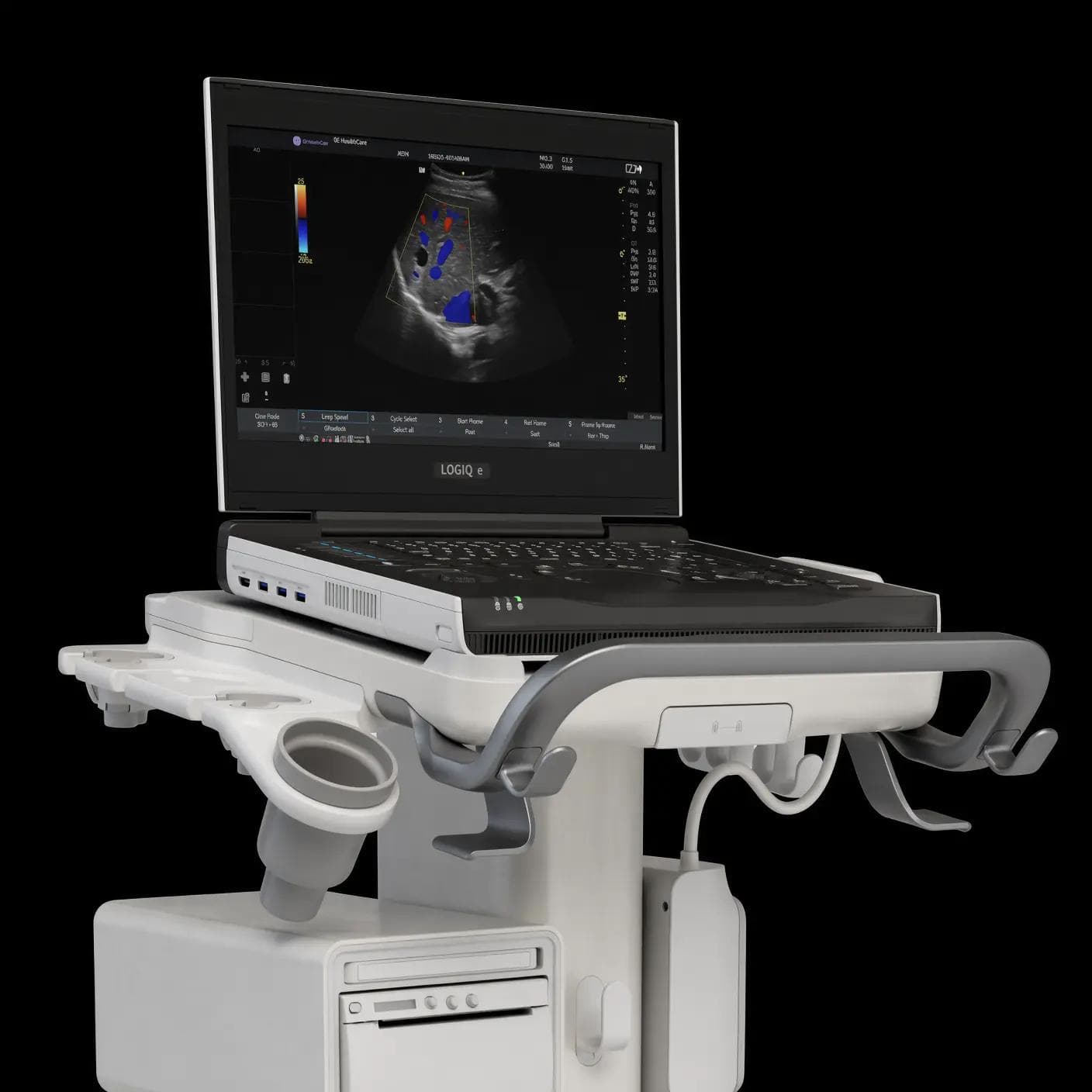
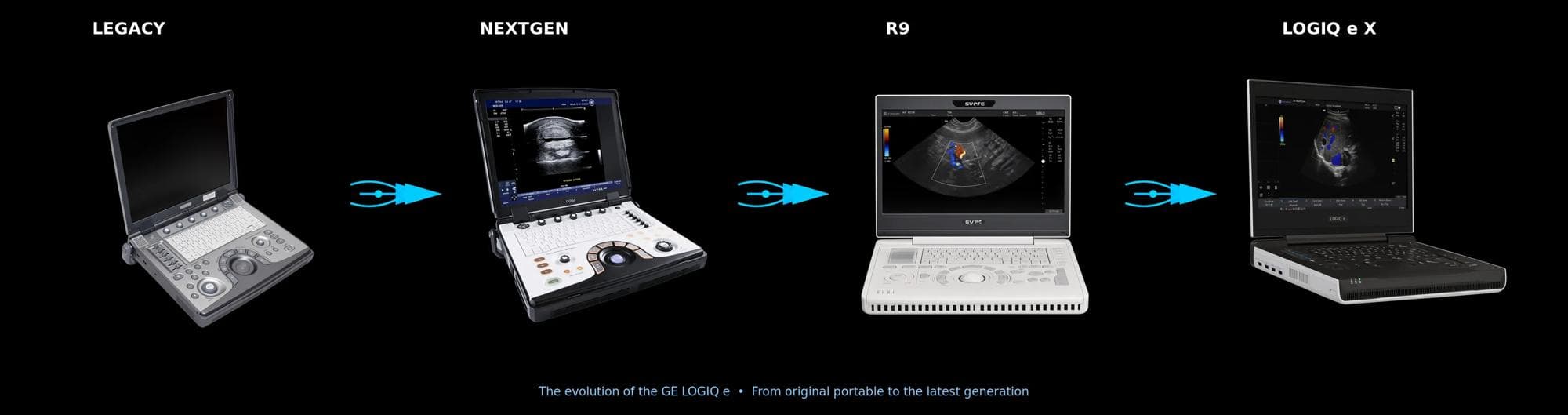
Why the GE LOGIQ e Still Matters
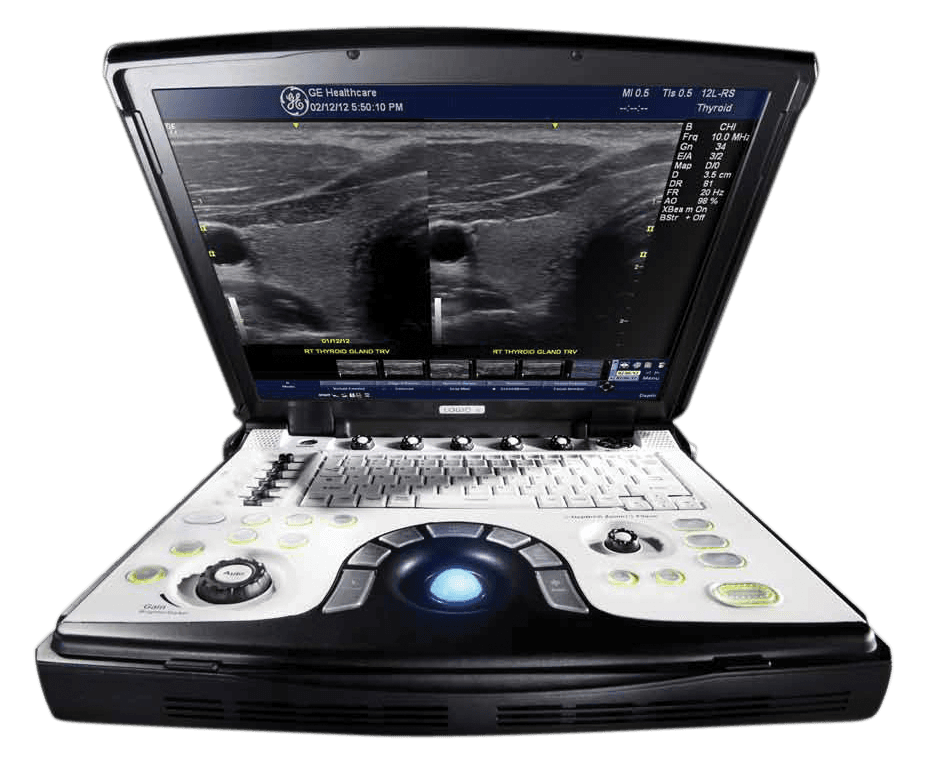
For nearly 15 years, the GE LOGIQ e has remained one of the more recognizable portable ultrasound systems in the clinical market. Its staying power comes from a simple mix: laptop-style mobility, a broad RS-pin probe ecosystem, and enough imaging range to support general imaging, MSK, vascular, OB/GYN, and other guided procedures. Instead of keeping scans tied to a dedicated ultrasound room, the LOGIQ e made portable imaging accessible where the patient already is, from procedure rooms to mobile clinics.
That long lifespan also means the LOGIQ e name covers several important versions, each rendition shaped by changes in software, hardware, imaging tools, and clinical workflow features. This article walks through the major LOGIQ e variations, including the original BT systems, and NextGen models, with a focus on how they differ in features and price range. The goal is to give buyers a clear historical guide to the LOGIQ e lineup, showing what changed over time and why these systems (old and new) still remain relevant in the portable ultrasound market.
History of the GE LOGIQ e Series
The LOGIQ e earned its place in portable ultrasound because it started with an ambitious idea: bring capable diagnostic imaging into a laptop-style system that could move beyond the dedicated ultrasound room. Over time, that early portability helped the LOGIQ e become a familiar standard in the portable ultrasound market, with each era refining how the system looked, scanned, and supported day-to-day clinical use. Some updates were visible facelifts, while others included deeper hardware and software upgrades that improved imaging performance and made the platform more practical for guided procedures.
The Original BT Era
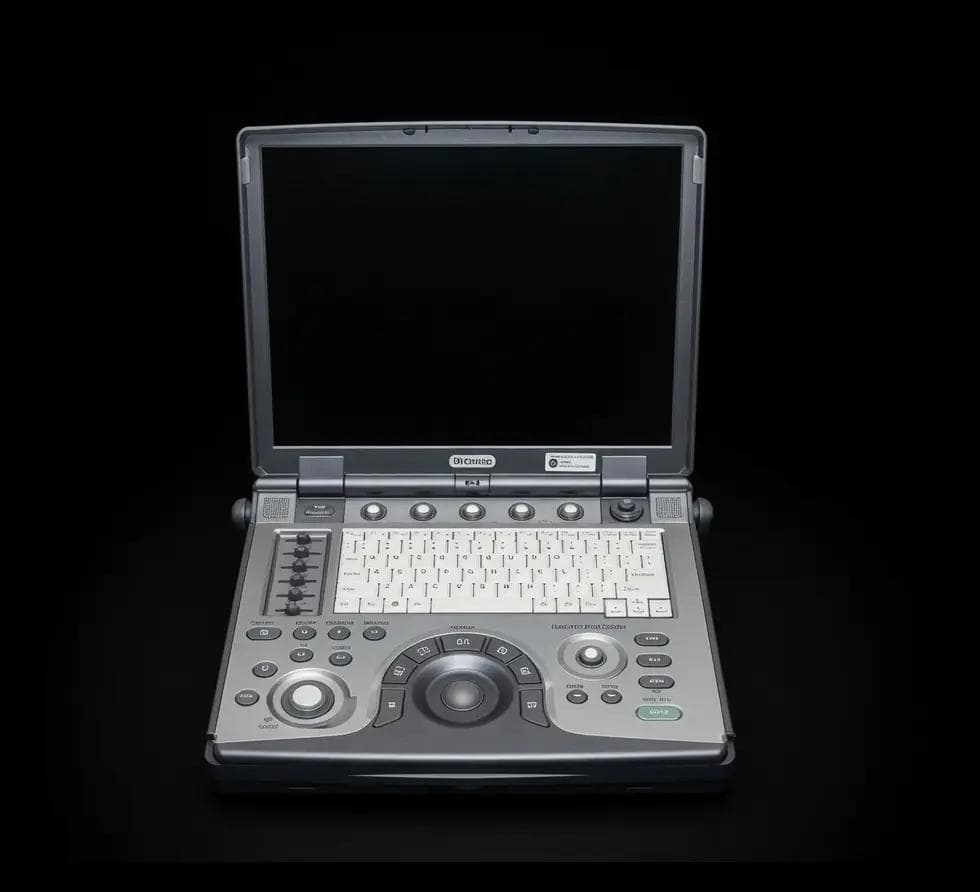
The original LOGIQ e is important because it proved that a portable ultrasound could be more than a backup machine. Its silver-body design became widely recognized, but its real value came from how much clinical range GE packed into a laptop-style system. Instead of being limited to one specialty, the early LOGIQ e could support everyday portable imaging across vascular, abdominal, OB/GYN, MSK, and basic cardiac use when configured with the right RS-pin probes.
A major reason this generation stayed popular was its probe flexibility. The 12L-RS supported vascular, small parts, and superficial MSK imaging, while the 4C-RS handled abdominal and transabdominal OB/GYN exams. The E8C-RS added endocavity pelvic imaging, and the 3S-RS gave the system basic cardiac capability when cardiac software and CW support were included. That probe mix made the original LOGIQ e useful for smaller practices that needed one portable system to cover several common exam types.
This era also introduced the BT, or "Breakthrough," software structure. These updates helped carry the original platform through multiple revisions, with BT11 becoming the highest software level for the silver LOGIQ e generation. That matters in the preowned market because BT11 represents the most complete version of the original platform, with the broadest support and strongest overall value among the early systems.
Today, the original BT systems are still relevant because they are familiar, serviceable, and cost-effective. They do not have the speed, processing, or advanced workflow tools of later generations, but they still offer dependable portable imaging for buyers who need a lower-cost entry point. For that reason, the BT11 remains the key model to look for when considering the first era of the LOGIQ e.
The BT12 Redesign
The BT12 generation was the first major redesign of the LOGIQ e platform. It kept the same portable laptop-style identity, but moved away from the older silver-body design into a more modern black chassis with an updated keyboard and display layout. This made BT12 feel like a true transition point in the LOGIQ e timeline, not just another software update on the original system.
The more important changes were in the clinical tools. Tissue Doppler Imaging gave the BT12 stronger cardiac-adjacent capability by helping evaluate tissue motion, rather than only showing blood flow through standard Doppler modes. For practices using the LOGIQ e as a shared portable system, that made the machine more flexible when basic cardiac assessment or myocardial motion needed to be part of the exam mix.
BT12 also added IMT measurement, which was especially useful for vascular users. IMT stands for intima-media thickness, a carotid artery wall measurement often used in vascular screening and cardiovascular risk assessment. Instead of treating the LOGIQ e as only a general portable scanner, this gave BT12 a more defined role in vascular workflows where measurement consistency mattered.
Those upgrades are why BT12 still stands apart from the earlier BT systems. The redesign made the machine look and feel newer, while TDI, IMT measurement, DICOM connectivity, and optional CWD support expanded what the platform could reasonably handle. It was not as advanced as the later NextGen models, but it became the bridge between the original LOGIQ e generation and the more modern R-series systems that followed.
The NextGen Era
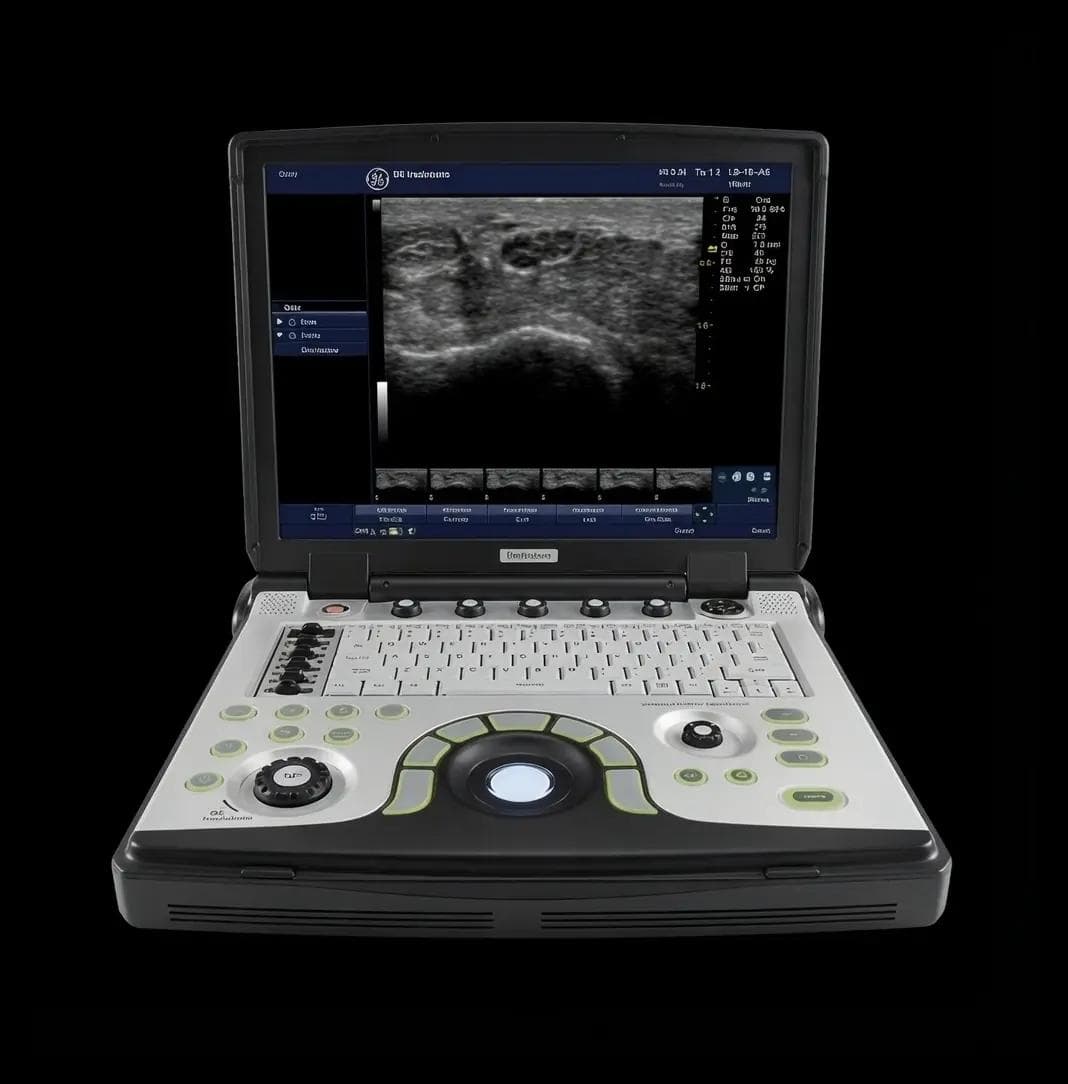
The NextGen R-series marked the next major step in the LOGIQ e timeline, covering the R6, R7, and R8 generations. The system kept the same laptop-style format, but the imaging platform became more capable underneath. This era introduced a stronger processing package, integrated SSD storage, HDMI output, three USB ports, and optional cart configurations with up to three probe ports, making the LOGIQ e feel faster and more practical for daily portable use.
The most important imaging upgrades in this generation were CrossXBeam and SRI. CrossXBeam improves the ultrasound image by combining information from multiple angles instead of relying on a single straight-line view. In practice, that helps sharpen tissue borders and reduce the grainy appearance that can make small structures harder to separate. For MSK, vascular, and general imaging, this made the LOGIQ e better at showing anatomy with cleaner edges and more consistent detail.
SRI, or Speckle Reduction Imaging, worked alongside that by reducing the noise pattern that naturally appears in ultrasound images. Instead of simply making the image look smoother, the goal was to clean up the background while preserving the structures that matter. This was especially useful in superficial imaging, where tendons, vessels, nerves, and soft tissue layers can sit close together on the screen. Together, CrossXBeam and SRI made the NextGen systems feel like a meaningful image-quality upgrade over the older BT models.
Taken together, R6 through R8 represent the generation where the LOGIQ e moved from a proven portable system into a more refined imaging platform. The upgrades did not change the basic identity of the machine, but they made it stronger for practices that needed better image processing, faster workflow, and broader probe support in a portable format. For buyers comparing used or rental LOGIQ e systems, this is why the NextGen era still stands out from the earlier BT machines.
The R9
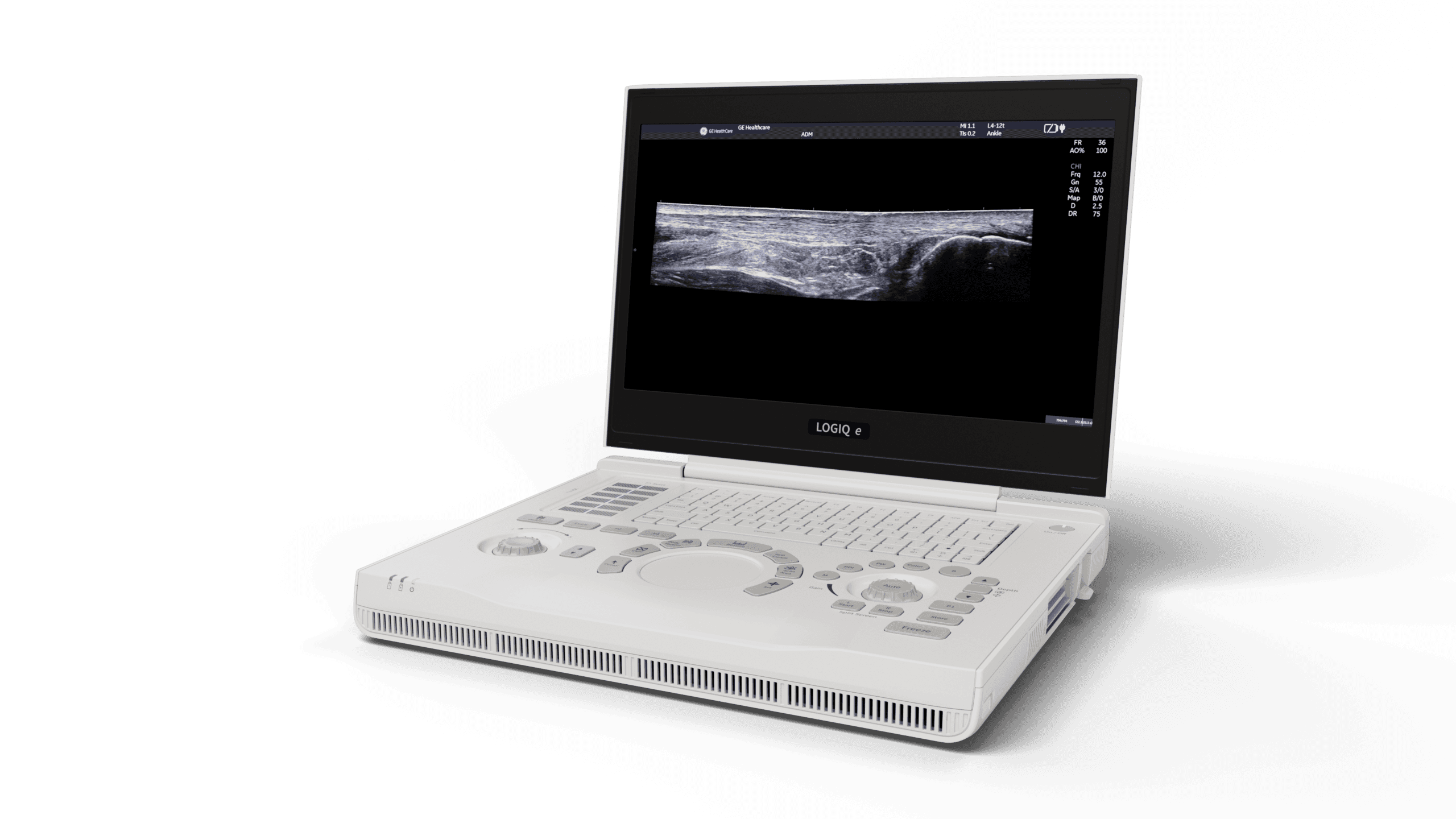
The R9 generation is best understood as the advanced portable era of the LOGIQ e. Instead of changing the system into a completely different machine, R9 refined the parts of the platform that matter most in daily clinical use: screen clarity, cleaning workflow, portability, and procedure support. Its 15.6-inch FHD display gave clinicians a larger and sharper viewing space, while the sealed keyboard and updated control layout made the system more practical for procedure rooms, shared exam spaces, and point-of-care use.
R9 also strengthened the LOGIQ e's role in guided procedures through AI Needle Recognition, which helps keep the needle visible during injections, biopsies, and nerve blocks. This matters because needle visibility is one of the biggest challenges in portable procedural ultrasound, especially when the needle enters tissue at a shallow or steep angle. By helping separate the needle path from surrounding anatomy, R9 made the LOGIQ e more practical for anesthesia, pain management, MSK, and other procedure-focused users. In the LOGIQ e timeline, R9 represents the point where the platform became more polished, more procedure-focused, and better suited for modern portable ultrasound workflows.
The New GE LOGIQ e X
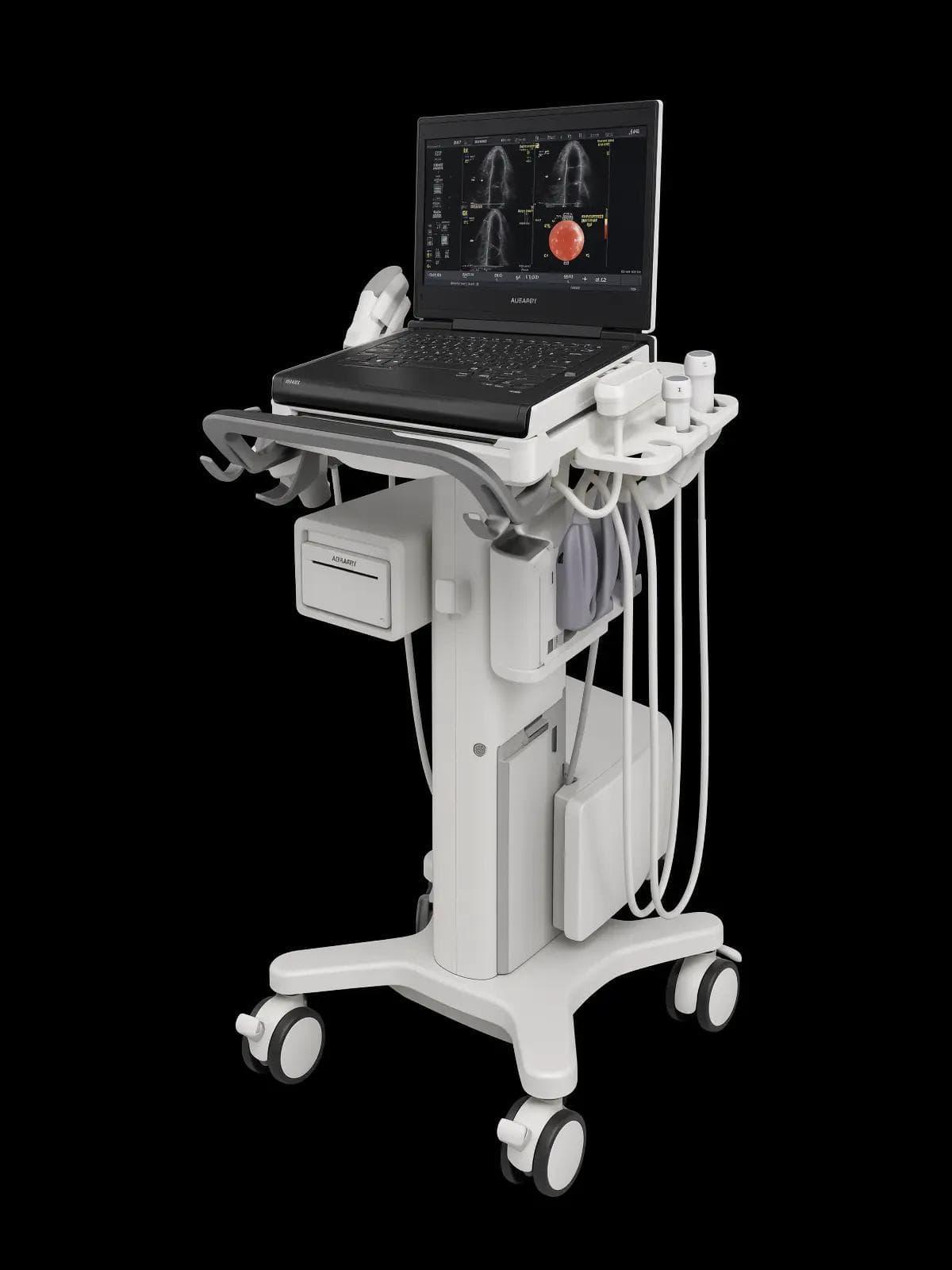
Released in 2026, the GE LOGIQ e X is the newest generation in the LOGIQ e portable ultrasound family. It replaces the former “what comes next” question with a production platform: a modern black, laptop-sized system designed to bring premium, AI-powered, console-quality ultrasound to the point of care. The LOGIQ e X is built for room-to-room use across MSK and sports medicine, anesthesiology, vascular, emergency medicine, critical care, cardiac, OB/GYN, and multipurpose imaging.
The biggest change is how much guidance and automation now fit into the portable platform. Nerveblox can automatically label key anatomical landmarks in real time during peripheral nerve block workflows, while MSK Go assists qualified users with scan-plane recognition and musculoskeletal structure detection. Voice Control supports hands-free adjustments such as gain and depth, and Scan Assistant can automate repetitive exam steps. The system also includes procedure and imaging tools such as Needle Recognition, B-Flow, SRI-HD, Auto EF, AFI, and SonoBiometry, with feature availability varying by configuration and region.
Probe and workflow flexibility also separate the LOGIQ e X from earlier BT, NextGen, and R9 systems. The platform supports expanded RS-pin options such as the C2-9-RS XDclear curved array, L4-20t-RS high-frequency linear, L6-12-RS, and IC9-RS, along with compatible Vscan Air CL and SL wireless dual-sided probes. Optional two- or three-probe connectors allow switching without reconnecting hardware, while two compact cart designs, dual-battery support, a low-noise fan, and Verisound collaboration and fleet tools extend the system from individual exam rooms to enterprise deployment.
For buyers, the distinction is now straightforward: earlier LOGIQ e BT and R-series systems remain lower-cost preowned or rental options, while the new GE LOGIQ e X ultrasound machine is the current choice for practices that want the newest AI-guided workflows, broader connectivity, and console-quality imaging in a portable system. Review the product page for current configurations, compatible probes, and quote information.
Best LOGIQ e Probes and Clinical Applications
Best probes by specialty
| Probe | Compatibility Models | Clinical Use | Probe Use & Description |
|---|---|---|---|
| 9L-RS | GE LOGIQ e BT06, BT08, BT09, BT10, BT11, BT12; NextGen LOGIQ e R6, R7, R8; LOGIQ e R9; LOGIQ e X | Vascular, small parts, MSK | A standard linear probe for buyers who need vascular and superficial imaging without moving into the highest-frequency MSK probes. It is useful for carotid, venous, thyroid, and general soft tissue scanning. |
| 4C-RS | GE LOGIQ e BT06, BT08, BT09, BT10, BT11, BT12; NextGen LOGIQ e R6, R7, R8; LOGIQ e X | Abdomen, OB/GYN, general imaging | The main convex option for many BT-era systems. Buyers looking at older LOGIQ e units should check for this probe if abdominal, pelvic, or transabdominal OB/GYN imaging is part of the exam mix. |
| C1-5-RS | NextGen LOGIQ e R6, R7, R8; LOGIQ e R9; LOGIQ e X | Abdomen, OB/GYN, general imaging, POCUS | A newer convex option for deeper abdominal and pelvic imaging. It is a practical choice for buyers who need a portable system that can cover abdominal work alongside point-of-care exams. |
| E8C-RS | GE LOGIQ e BT06, BT08, BT09, BT10, BT11, BT12; NextGen LOGIQ e R6, R7, R8; LOGIQ e R9; LOGIQ e X | OB/GYN, pelvic imaging, endocavity exams | The core endocavity probe across the LOGIQ e lineup. It matters most for buyers performing pelvic, gynecologic, fertility, or early pregnancy exams. |
| 3S-RS | GE LOGIQ e BT06, BT08, BT09, BT10, BT11, BT12 | Cardiac POCUS, basic echo | The BT-era phased array option for focused cardiac work. Buyers considering older BT systems should confirm this probe and the installed cardiac/CW software if cardiac scanning is required. |
| 3Sc-RS | NextGen LOGIQ e R6, R7, R8; LOGIQ e R9; LOGIQ e X | Cardiac POCUS, focused echo, bedside cardiac views | The newer phased array option for R-series systems. It is the better fit for buyers comparing NextGen units for cardiac windows, focused echo, and broader POCUS coverage. |
| 6S-RS | GE LOGIQ e BT06, BT08, BT09, BT10, BT11, BT12; NextGen LOGIQ e R6, R7, R8; LOGIQ e R9; LOGIQ e X | Pediatric cardiac, neonatal, fetal heart | A compact phased array option with broad generational support. It is most relevant for buyers who need pediatric, neonatal, or fetal-heart-style imaging from a portable platform. |
| 8C-RS | GE LOGIQ e BT06, BT08, BT09, BT10, BT11, BT12; NextGen LOGIQ e R6, R7, R8; LOGIQ e R9; LOGIQ e X | Pediatric abdomen, neonatal, small-patient general imaging | A microconvex probe for smaller patients and tight scanning windows. It helps buyers cover pediatric abdominal exams, neonatal imaging, and general small-patient use without relying on a larger convex probe. |
| L8-18i-RS | GE LOGIQ e BT11, BT12; NextGen LOGIQ e R6, R7, R8; LOGIQ e R9; LOGIQ e X | MSK, vascular access, nerve imaging, small parts | A high-frequency hockey-stick probe for tight anatomy. It is useful for hands, wrists, ankles, small joints, vascular access, and procedures where a standard linear probe is too wide. |
| L10-22-RS | NextGen LOGIQ e R6, R7, R8; LOGIQ e R9; LOGIQ e X | Superficial MSK, rheumatology, dermatology, small parts | The high-frequency option for buyers who need fine superficial detail. It is best suited for small joints, tendons, superficial nerves, and other near-field anatomy where resolution is more important than depth. |
| C2-9-RS | GE LOGIQ e X | Abdominal, OB/GYN, general imaging, MSK | An XDclear curved-array probe introduced for the LOGIQ e X, providing broad abdominal and pelvic coverage with expanded bandwidth for portable multipurpose imaging. |
| L4-20t-RS | GE LOGIQ e X | MSK, sports medicine, rheumatology, superficial imaging | A high-frequency linear probe reaching 20 MHz for tendons, ligaments, small joints, superficial nerves, and detailed near-field imaging on the newest LOGIQ e X platform. |
| IC9-RS | GE LOGIQ e X | OB/GYN, pelvic imaging, endocavity exams | A compact wide-band microconvex endocavity probe for pelvic and gynecologic imaging on the LOGIQ e X. |
| Vscan Air CL / SL | GE LOGIQ e X | Wireless POCUS, abdomen, vascular, cardiac, superficial imaging | Wireless dual-sided probes that combine curved and linear arrays (CL) or sector and linear arrays (SL), integrating handheld acquisition with the processing power of the LOGIQ e X. |
Understanding "t-style" probes
The L4-12t-RS and 12L-RS t-style probes are compatible options for the GE LOGIQ e X. Their programmable handle buttons let clinicians freeze, store, or adjust images without reaching back to the ultrasound keyboard, which can streamline vascular, MSK, small-parts, and procedure workflows.
| Probe | Frequency Range | Confirmed Compatible Models | Best For | Why It Matters |
|---|---|---|---|---|
| L4-12t-RS | 4.2–13.0 MHz | LOGIQ e R7, LOGIQ e R8 | Small parts, MSK, pediatric, breast | A wideband linear RS-pin probe with a 47.1 mm field of view, up to 6 cm depth, and configurable ergonomic buttons. It is useful when high-frequency detail and easier probe-side control matter during compact, hands-on scanning. |
| 12L-RS | 4.2–13.0 MHz | LOGIQ e BT11, LOGIQ e BT12, LOGIQ e R7, LOGIQ e R8, | Vascular, small parts, MSK, breast | A standard wideband linear RS-pin probe with up to 10 cm depth and a 38.4 mm field of view. It is a strong everyday linear probe for vascular, soft tissue, and MSK imaging, but it does not have the same configurable button design as the t-style probes. |
"Clinicians bring the expertise, but medical technology gives them the visibility, speed, and confidence to use that expertise when it matters most.”
Buying Guide: Which LOGIQ e Should You Choose?
Choosing the right GE LOGIQ e ultrasound system is less about finding the cheapest unit and more about matching the system to your clinical workflow. Before you compare prices, make sure the system fits your specialty, supports the probes you need, and has the software and support to hold up in daily use.
| Buying Option | Best For | Main Consideration |
|---|---|---|
| New / Current Model | Practices that want the latest workflow, support, and warranty | Higher upfront cost |
| Refurbished | Buyers who want strong value with tested performance | Confirm warranty, probes, and software |
| Preowned | Budget-focused buyers | More inspection risk |