
GE Ultrasound Feature
Dual-Probe
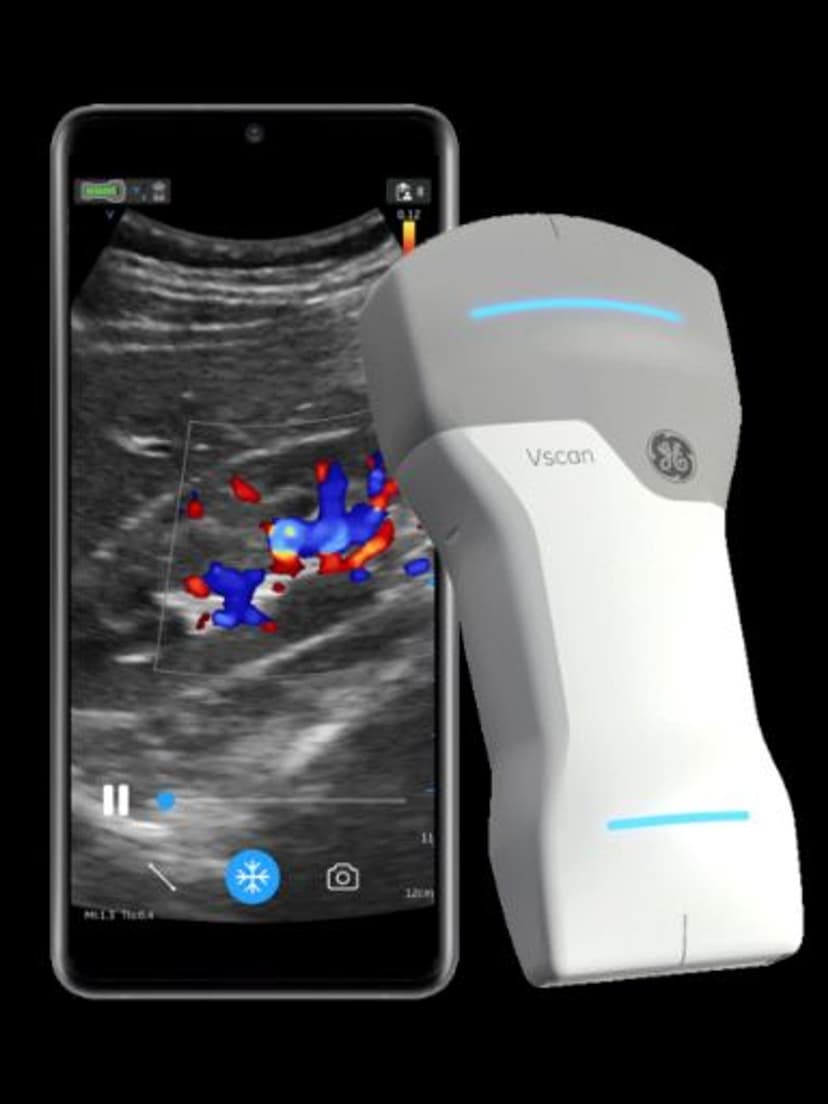
WorkflowDual-Probe refers to the Vscan Air's unique hardware design: a single wireless transducer with two independent arrays built into opposite sides of the probe head. One side houses a linear array for superficial imaging (vascular access, MSK, thyroid, lung), and the other side has a curved (sector) array for deeper structures (cardiac, abdominal, FAST exam). Clinicians flip the probe to switch imaging modes instantly, with no cable swapping, no reconnection, and no workflow interruption. This two-in-one design makes the Vscan Air a complete point-of-care imaging tool in a pocket-sized device, particularly for physicians who need both vascular access guidance and cardiac assessment during the same patient encounter.

Key Benefits
Why Dual-Probe matters
Two imaging arrays in one pocket-sized device
The linear and curved arrays built into opposite sides of the probe head cover superficial through deep anatomy. Clinicians carry one device instead of two probes or a larger system with multiple transducer ports.
Instant array switching by flipping the probe
No cable disconnection, no menu navigation, no reconnection delay. The system auto-detects which array face is active and loads the matching preset. Mid-exam transitions between vascular and cardiac imaging take less than a second.
Complete POCUS capability for multi-system assessments
Emergency physicians performing a FAST exam, lung check, and vascular access assessment can do all three with a single Vscan Air. The dual-probe design supports the full spectrum of bedside point-of-care protocols.
Reduced equipment cost and inventory for mobile teams
Instead of purchasing separate transducers for cardiac and vascular imaging, practices invest in one Vscan Air per clinician. For mobile services, home visits, and disaster response, this simplifies equipment logistics and lowers total cost of ownership.
About Dual-Probe
Traditional handheld ultrasound devices use a single transducer array, forcing clinicians to choose between a phased array (deeper penetration, smaller footprint for cardiac) or a linear array (higher frequency, better resolution for superficial structures). The Vscan Air eliminates this tradeoff by integrating both array types into one probe. The linear side operates in the 3.5–12 MHz range for high-resolution imaging of vessels, nerves, lungs, and musculoskeletal structures. The curved side operates in the 1.5–4.5 MHz range for cardiac views, abdominal scanning, and FAST exams. Switching between arrays is instant: the clinician simply flips the probe over. The Vscan Air's software automatically detects which side is in use and loads the appropriate imaging preset. A hospitalist performing a FAST exam can check for free fluid with the curved array, then flip the probe to assess IV access sites with the linear array, all within the same workflow. The wireless Bluetooth connectivity to iOS or Android devices means no cables at all. For emergency departments, mobile response teams, and rural clinics, the Dual-Probe design replaces the need to carry multiple transducers or a larger system with dedicated probe ports.
Availability
Available on these systems
Our Partners


















Want Dual-Probe in your practice?
Request a quote for a system that includes this feature.